Key Design Features
Compact 9-Pin Micro-D Interface
Dual Micro-D 9-pin female connectors save installation space in compact electronic equipment.
Straight-Through Wiring
One-to-one pin mapping from 1 to 9 simplifies wiring verification, integration, and maintenance.
Shielded Cable Construction
Braided shielding connects to the connector shells to help reduce electromagnetic interference.
Screw-Lock
Retention
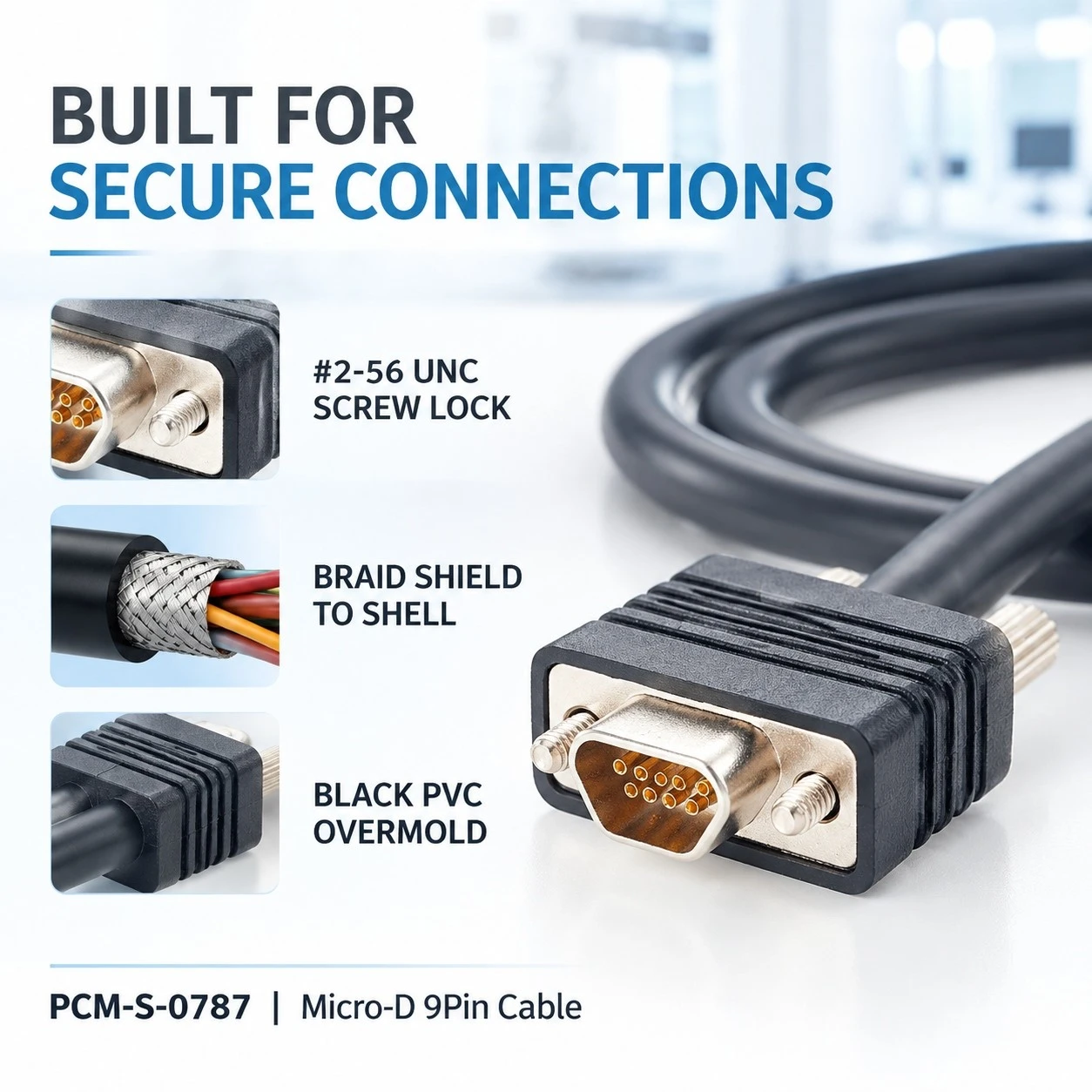
#2-56 UNC locking screws improve connection retention and reduce accidental loosening.
What Is a Micro DB9 Female to Female Cable?
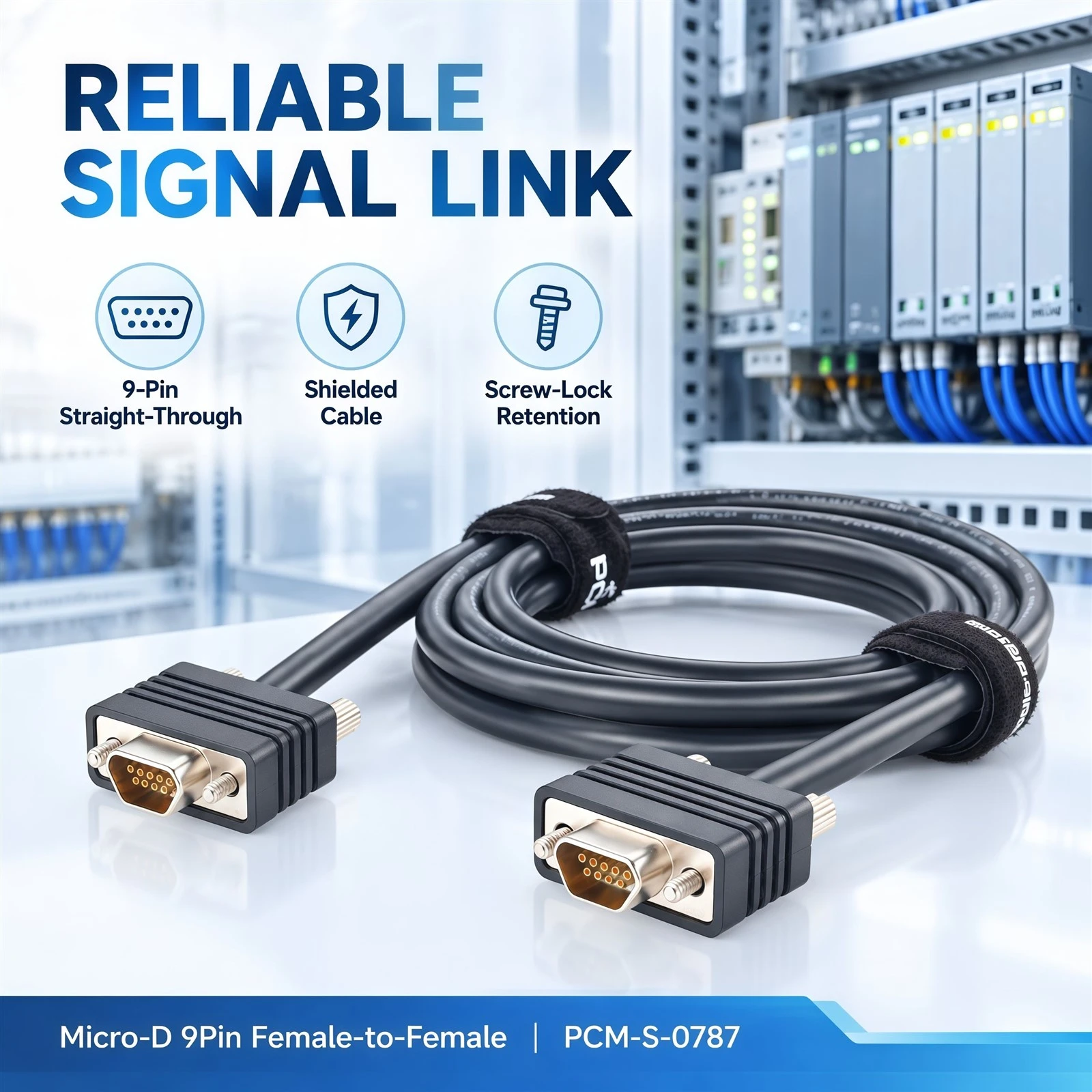
A Micro DB9 female-to-female signal cable is a compact industrial interconnect with Micro-D 9-pin female connectors on both ends. It carries 9 channels of signal over individual 28 AWG conductors, with the shell connected to braid and drain wire for shielding continuity.
Unlike standard DB9 cables, which use the larger D-sub footprint with #4-40 screws, the Micro-D interface uses a smaller housing with #2-56 UNC screws. The female-to-female configuration is used to bridge two devices that both have Micro-D male pins, avoiding the need to stack separate adapter couplers.
In the PCM-S-0787, the internal wiring is 1:1 straight through: Pin 1 to Pin 1, Pin 2 to Pin 2, through Pin 9 to Pin 9, with the shell bonded to the braided shield on both ends. The cable passes 100% open, short and miswire testing before shipment, with insulation resistance of at least 20 MOhm.
Why Use a Pre-Assembled Micro-D Signal Cable?
During equipment development, production, and maintenance, connectors and cables must be matched as a complete assembly. Purchasing separate connectors and loose wire for on-site fabrication adds work related to termination, wiring verification, and quality inspection.
PCM-S-0787 integrates both connectors, nine signal conductors, shielding, and locking hardware into a pre-assembled component. For equipment with matching Micro-D interfaces, this approach can simplify assembly, maintain consistent wiring definitions, and facilitate replacement and maintenance.
The product is particularly suitable for projects requiring a defined cable length, corresponding pin assignments, and screw-based mechanical retention. However, it is not a universal adapter for every 9-pin interface and should not replace another cable without verifying mechanical and electrical compatibility.
Typical Applications
Industrial Automation and Control
Supports signal connections between PLCs, I/O modules, and industrial control equipment.
Data Acquisition and Measurement
Suitable for data acquisition devices, precision instruments, and laboratory electronics.
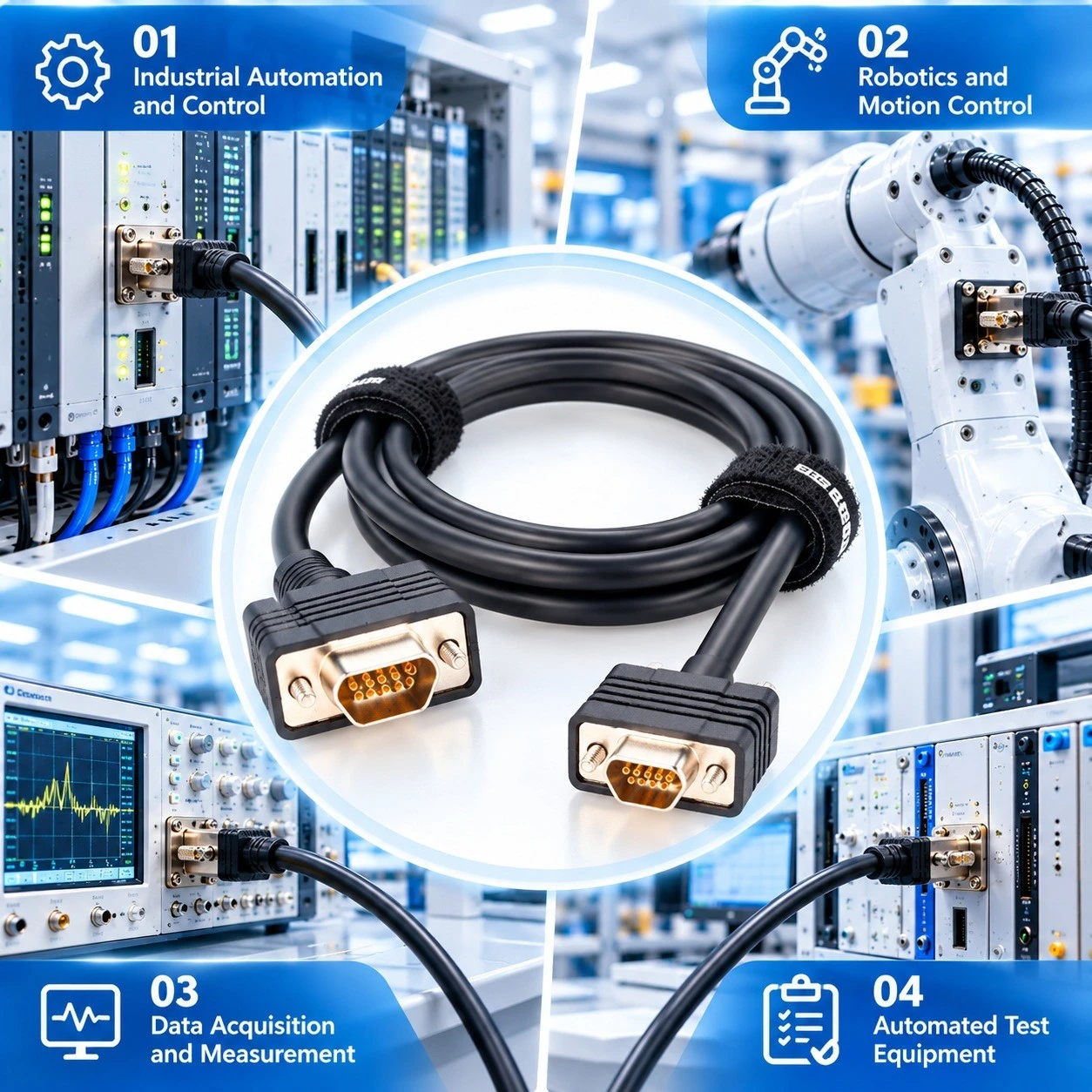
Robotics and Motion Control
Connects robotic control systems, motion-control modules, and related equipment.
Automated Test
Equipment
Supports signal transmission between test controllers, automated test systems, and test modules.
Micro DB9 Female-to-Female vs Micro DB9 Male-to-Standard DB9
How to Choose a Micro DB9 Female to Female Cable?
Confirm Both Device Ends Are Micro-D Male
Before selecting a female-to-female cable, inspect the connectors on both devices. If one device uses a standard DB9 port instead of Micro-D, the PCM-S-0788 (Micro-D male to standard DB9 male) is the correct choice. The PCM-S-0787 should only be selected when both devices use Micro-D male connectors.
Select Length Based on Cabinet Distance
The standard PCM-S-0787 length is 1.5 m, which suits most intra-cabinet and rack-mounted interconnection needs. For panel wiring, custom machine builds or specific distances, Premier Cable supports OEM length customization according to customer drawings.
Verify Pin Assignment
The PCM-S-0787 uses 1:1 straight-through wiring on all 9 pins. Most industrial Micro-D applications follow this standard pinout. However, some special-purpose devices use non-standard pin assignments. Confirm the device pinout before ordering, especially for proprietary OEM equipment.
Consider Shielding and Environment
For industrial environments with servo drives, VFDs and switching power supplies, the braid shielding and shell-to-shell bonding help reduce electromagnetic interference. For clean room or laboratory use, the UL2464 PVC jacket provides reliable protection. Check bend radius and screw torque when planning the installation.
Typical connection solutions include:
Solution 1: Two Micro-D Male-Out Compact Devices
Device A (Micro-D Male) → PCM-S-0787 Female-to-Female Cable → Device B (Micro-D Male)
Suitable for connecting two compact industrial devices with Micro-D male connectors.
Solution 2: Micro-D to Standard DB9 Adapter
Micro-D Male Device → PCM-S-0788 Micro-D to Standard DB9 Cable → Standard DB9 Host
Suitable when one end is Micro-D and the other end uses a standard DB9 port.
Solution 3: Short Cabinet Patch
Two Micro-D male devices close together → PCM-S-0787 female-to-female patch cable for direct, shielded interconnection.
Product FAQ
What connectors are on each end?
Both ends are Micro DB9 9-pin female connectors. The shells are nickel-plated with #2-56 UNC locking screws, and the connector boots are overmolded in black PVC.
Are both ends female connectors?
Yes. Both ends use Micro-D 9-pin female connectors. Confirm that the equipment has compatible male-pin interfaces and verify the connector dimensions and mounting arrangement before connection.
What is the pin assignment?
The cable uses 1:1 straight-through wiring on all 9 pins, with the shell bonded to the braided shield on both ends. Every assembly is 100% tested for open, short and miswire before shipment, with insulation resistance of at least 20 MOhm.
What is PCM-S-0787 used for?
PCM-S-0787 is a Micro DB9 9-pin female-to-female signal cable. It is used to interconnect two compact industrial devices that both have Micro-D male connectors, such as PLC expansion modules, robot controller I/O boards, DAQ modules and ATE test equipment.