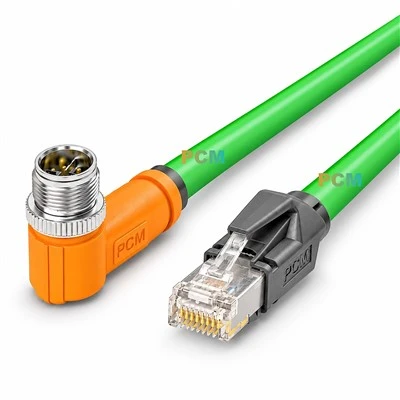
The main differences between M12 D-code and M12 X-code are purpose, data transmission capacity and internal structure:
1. Purpose
- M12 D-code: Mainly used for industrial Ethernet (Ethernet/IP, PROFINET, etc.) and fieldbus connections, suitable for 100 Mbps (Fast Ethernet) level industrial communications.
- M12 X-code: Designed for high data rate applications, widely used in Gigabit Ethernet (1000 Mbps) and higher bandwidth demand scenarios such as industrial automation, machine vision, rail transportation and smart factories.

2. Data transmission capacity
- M12 D-code: Supports 100 Mbps (Cat5e level) Ethernet connection.
- M12 X-code: Supports up to 10 Gbps (Cat6a level) Ethernet connection.
3. Internal structure
- M12 D-code: 4 pins (4P), 1-2 pairs for data transmission, 3-4 pairs for power or signal ground.
- M12 X-code: 8 pins (8P), similar in design to RJ45 Cat6a, with shielded twisted pair structure to ensure signal integrity of high-speed data transmission.

4. Appearance and mechanical characteristics
- M12 D-code: threaded connection, 4 pins, pin distribution shape similar to "D" shape (to avoid mis-insertion).
- M12 X-code: threaded connection, 8 pins, internal "X-shaped shielding" design to reduce crosstalk and EMI interference.
5. Typical applications
| Type | Typical applications |
| M12 D-code | Industrial Ethernet (100 Mbps), PLC, I/O modules, sensors, fieldbus devices |
| M12 X-code | High-speed data transmission (1 Gbps - 10 Gbps), machine vision, industrial computers, high-definition video transmission |
If your application requires higher speed, lower latency, and stronger anti-interference ability, choose M12 X-code; if it is just standard industrial Ethernet communication, M12 D-code is sufficient.